
Your Engagement Survey Identified a Problem. Can Emotional Intelligence Help Solve It?
Key takeaways:
- Engagement is connected to outcomes such as productivity, profitability, retention, absenteeism, safety, and quality.
- EI development can help leaders strengthen the communication, feedback, and relationship skills that influence engagement.
- Connecting engagement data, observable behaviors, and business measures can make the impact of development easier to see.
Employee engagement is often discussed as a people priority, but its effects extend well beyond employee sentiment. Engagement is associated with organizational outcomes that matter across an organization, including productivity, profitability, employee retention, workplace safety, customer satisfaction and loyalty.1
This makes engagement a measurable business issue. It also raises an important question: once an engagement survey identifies a problem, what should the organization do next?
Engagement surveys can reveal that employees do not feel heard, supported, recognized, or connected to the organization’s direction. However, measuring these experiences does not automatically give leaders the skills they need to address them. A survey may show that employees lack confidence in leadership communication, for example, but it cannot teach a leader how to listen with greater empathy, communicate through uncertainty, or respond constructively when an employee raises a concern.
To realize a return on investment in engagement, an organization must be able to translate survey findings into meaningful action. Emotional intelligence (EI) can play an important role in that process by helping leaders and employees develop some of the emotional and social skills that shape everyday workplace experiences.
Why employee engagement is a business issue
Engagement is not simply a measure of whether employees are happy at work. It reflects how involved and connected employees are to their work and workplace, and research has consistently linked it with important organizational outcomes.
In an analysis of 736 studies, 347 organizations, and more than 3.3 million employees, recent research by Gallup found that engagement was connected to every business outcome it examined. These included profitability, productivity, turnover, absenteeism, safety, work quality, customer loyalty, and organizational citizenship.2
Compared with the least engaged teams, the most engaged teams achieved:
- 23% higher profitability
- 18% higher sales productivity
- 14% higher productivity based on production records and evaluations
- 78% lower absenteeism
- 32% fewer quality defects
These findings do not mean that every engagement initiative will produce the same results. They do demonstrate, however, that engagement is associated with outcomes leaders already monitor and that failing to respond to disengagement can create meaningful business risk.
The challenge is that organizations sometimes devote more attention to measuring engagement than to building the capabilities needed to improve it. A survey score establishes where an organization is today. Creating a different employee experience requires leaders and teams to change what happens next.
The connection between emotional intelligence and engagement-related outcomes
Many of the factors that shape engagement are experienced through everyday interactions.
Employees notice whether their manager listens to them, recognizes their contributions, communicates clearly, follows through on concerns, provides useful feedback, and supports their development. They also notice how leaders respond under pressure, manage disagreement, and communicate during periods of uncertainty.
These behaviors are influenced, in part, by EI.
EI refers to the emotional and social skills people use to understand and express themselves, develop and maintain relationships, make decisions, and manage challenges. By strengthening how people communicate, collaborate, and respond to one another, EI can help create the everyday workplace experiences that foster engagement. It influences the human interactions through which organizational policies and practices are communicated and put into action.
A 2022 research review linked higher EI with greater job satisfaction, organizational commitment, positive workplace contributions, and job performance, as well as lower job stress.3 Another review found that employees with higher EI tended to be more satisfied at work, more committed to their organizations, and less likely to consider leaving.4 These connections remained meaningful even when researchers considered factors such as personality and cognitive ability.
Engagement is influenced by a wide range of individual, managerial, cultural, and organizational factors. However, the research suggests that EI can support several conditions associated with a more engaging workplace.
From survey result to development priority
Engagement results become more useful when organizations move beyond identifying a concern and examine the everyday behaviors that may be contributing to it.
“Employees do not feel heard.”
The instinctive response may be to schedule more listening sessions or ask leaders to collect additional feedback. But if leaders become defensive, dismiss concerns, or fail to acknowledge different perspectives, collecting more feedback is unlikely to change the employee experience.
Development may need to focus not on creating more opportunities to listen, but on strengthening how leaders receive and respond to what employees share. This includes empathy, active listening, open emotional expression, and the ability to respond assertively without shutting down the conversation.
“Communication is unclear or inconsistent.”
This finding may point to a need for more frequent communication, but frequency alone does not guarantee clarity. Leaders also need to recognize how their own emotional state affects their message, communicate expectations directly, consider how information may be received, and check for understanding.
Relevant development areas may include emotional self-awareness, emotional expression, empathy, and assertiveness.
“Employees do not receive meaningful feedback or recognition.”
The solution is not simply to tell managers to provide more feedback. Effective feedback requires a balance of clarity, empathy, timing, and self-management. Managers need to address difficult issues directly while creating a conversation in which employees can listen, ask questions, and act on what they hear.
“Employees feel unsupported during change.”
Uncertainty can quickly undermine trust when leaders minimize legitimate concerns or communicate with false confidence. Leaders need to acknowledge how employees are experiencing the change, distinguish facts from assumptions, adapt as circumstances evolve, and help teams move forward without dismissing the difficulty of the situation.
Flexibility, stress tolerance, empathy, optimism, and reality testing may all be relevant to this goal.
This analysis should not be used to place responsibility for disengagement entirely on individual employees or managers. If survey findings reveal excessive workloads, inequitable practices, inadequate staffing, limited resources, or other structural problems, those issues require structural action. EI development is most useful when it is connected to problems that emotional and social behaviors can realistically influence.
How EQ-i 2.0 can support a more targeted response
Once an organization has connected an engagement concern to the behaviors that may be reinforcing it, the next step is to identify where development should begin. A validated EI assessment can bring greater structure and focus to that process.
MHS’ Emotional Quotient-Inventory™ 2.0 (EQ-i 2.0®) is a self-report assessment that measures emotional and social skills across five composite areas and 15 interconnected subscales. This framework can help practitioners identify focused development priorities, set relevant goals, and evaluate progress over time.
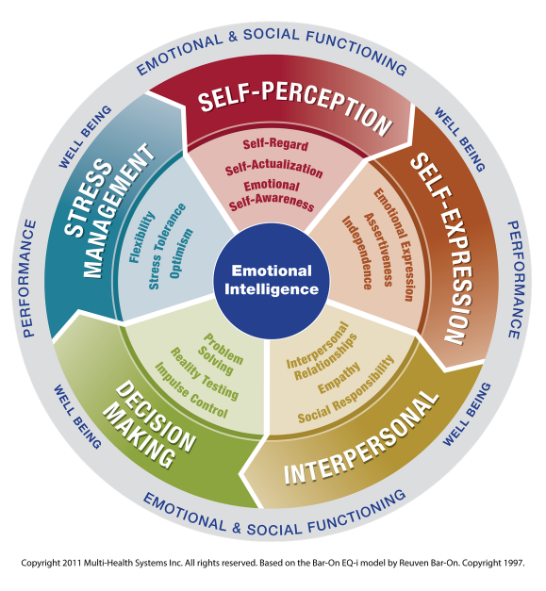
Importantly, EQ-i 2.0 does not measure employee engagement. Instead, it can help organizations examine emotional and social skills that may influence how people lead, communicate, collaborate, make decisions, and respond to pressure.
As part of a broader engagement strategy, the assessment can help organizations:
Establish a structured starting point
Engagement surveys provide information about employees’ workplace experiences. EQ-i 2.0 results provide a different type of insight by helping individuals explore patterns in their emotional and social functioning.
Together, these sources can help an organization move from a broad concern, such as “employees do not feel heard,” to a more focused development question: Which behaviors could leaders strengthen to create more open and constructive conversations?
Focus development on specific skills
Broad objectives such as “improve communication” or “become a better leader” are difficult to translate into action. EQ-i 2.0 results can help individuals select focused development areas and connect them to observable workplace behaviors.
For example, a leader may set a goal to invite employee perspectives before making a decision, pause before responding defensively, or check for understanding at the end of an important conversation.
Create a shared language
Engagement problems are sometimes described using broad terms such as communication, leadership, trust, or culture. A structured EI framework can help leaders, coaches, and employees discuss the emotional and social behaviors contributing to those experiences with greater precision.
Support practical development plans
Insight is only useful when it leads to action. EQ-i 2.0 results can inform goals that are connected to actual workplace situations, including feedback conversations, team meetings, conflict, decision-making, coaching, and organizational change.
How to make the impact of EI development visible
Demonstrating the value of EI development requires more than tracking participation or assessment completion. Organizations need to connect development activities to the employee behaviors and business outcomes they are intended to influence.
Begin with a defined business need: Identify the problem the organization is trying to address, such as low confidence in managers, poor communication during change, unwanted turnover, recurring team conflict, or low feedback and recognition scores.
Establish a starting point: Use relevant engagement results, employee feedback, business metrics, behavioral observations, and EQ-i 2.0 results to understand where individuals and teams are starting.
Identify the behaviors that need to change: Replace broad goals such as “improve engagement” with observable actions. These might include holding more consistent development conversations, inviting employee input, providing timely recognition, responding constructively to concerns, or communicating change more clearly.
Track employee and business outcomes over time: Measure progress using a combination of behavioral feedback, engagement results, goal attainment, retention, absenteeism, productivity, quality, or other indicators connected to the original business need.
EQ-i 2.0 results may provide one source of evidence, but they should not be treated as the only measure of success. Looking at several indicators creates a more credible connection between development, workplace behavior, employee experience, and business outcomes.
Turn engagement insights into meaningful action
To generate meaningful business impact, organizations must translate engagement data into action. That may require changes to policies, resources, workloads, or organizational practices. It may also require leaders and employees to develop the emotional and social skills that influence how they communicate, collaborate, manage pressure, make decisions, and build trust.
Research connects employee engagement with outcomes such as profitability, productivity, absenteeism, turnover, safety, and quality. It also connects EI with several engagement-related outcomes, including job satisfaction, organizational commitment, job performance, and job stress.
EQ-i 2.0 can support the developmental part of an engagement strategy by establishing a structured starting point, identifying focused areas for growth, and helping translate broad engagement concerns into observable workplace behaviors. When that development is tied to a defined business need and measured alongside employee and organizational outcomes, the return becomes easier to see.
The objective is not simply to achieve a higher engagement score. It is to create meaningful changes in how people experience work and to connect those changes to outcomes the organization values.
Move from engagement insights to focused development: Explore the EQ-i 2.0 to build a more targeted approach to emotional intelligence development.
Want more insights like this delivered to your inbox? Subscribe to receive the latest articles, research, and resources from MHS.
References
1 Harter, J. K., Schmidt, F. L., & Hayes, T. L. (2002). Business-unit-level relationship between employee satisfaction, employee engagement, and business outcomes: A meta-analysis. Journal of Applied Psychology, 87(2), 268–279. https://doi.org/10.1037/0021-9010.87.2.268
2 Kemp, A. (2024). Q12 meta-analysis: The relationship between engagement at work and organizational outcomes (11th ed.). Gallup. https://www.gallup.com/workplace/321725/gallup-q12-meta-analysis-report.aspx
3 Doğru, Ç. (2022). A meta-analysis of the relationships between emotional intelligence and employee outcomes. Frontiers in Psychology, 13, 611348. https://doi.org/10.3389/fpsyg.2022.611348
4 Miao, C., Humphrey, R. H., & Qian, S. (2017). A meta-analysis of emotional intelligence and work attitudes. Journal of Occupational and Organizational Psychology, 90(2), 177–202. https://doi.org/10.1111/joop.12167