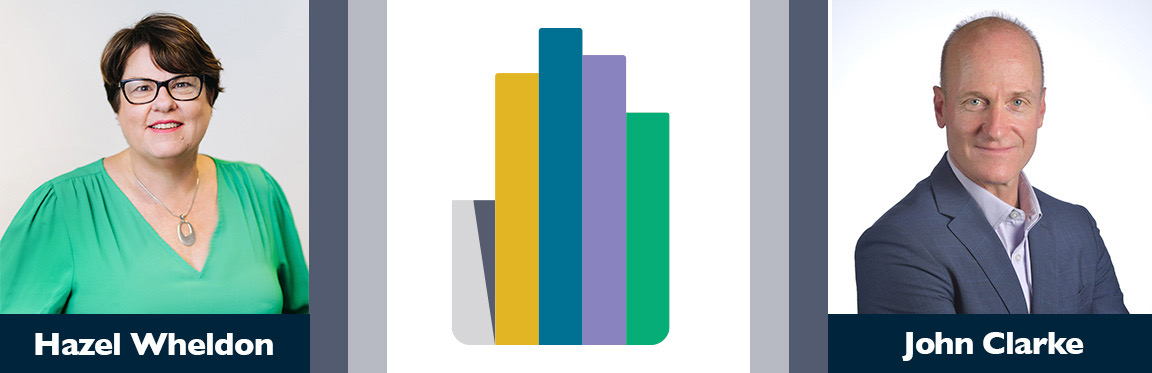
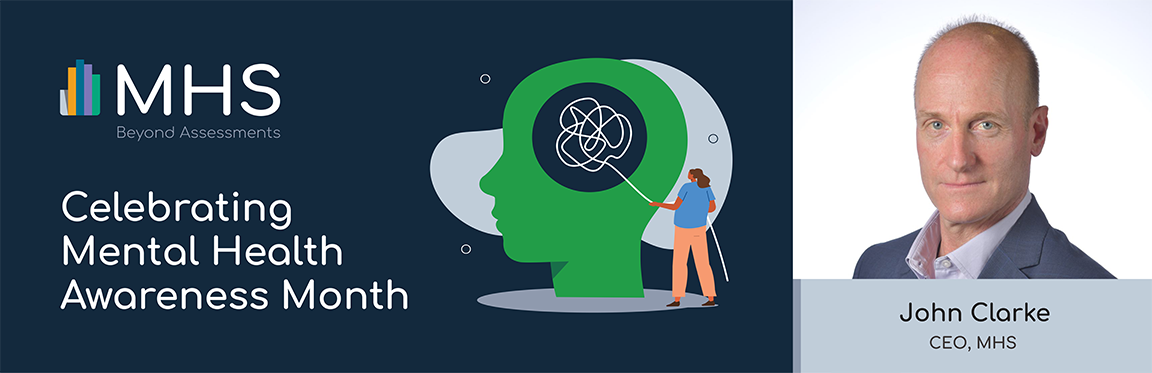
In Conversation with John Clarke, CEO at MHS, for Mental Health Awareness Month
At MHS, our mission has always been rooted in helping people reach their full potential, and mental health plays a foundational role in that work.
This Mental Health Awareness Month, the focus is on coming together to create more good days, together. That commitment goes beyond awareness at MHS, where we help translate insight into action through science‑backed assessments that support accurate understanding, diagnosis, and meaningful intervention across communities.
In that spirit, MHS’ CEO John Clarke explores the role of emotional intelligence (EI) in building healthier teams, reducing stigma, and creating environments where people can truly thrive in the workplace and beyond.
At MHS, we often talk about EI as a foundation for effective collaboration. How do you think emotionally intelligent teams create healthier, more supportive environments for mental well-being?
JOHN: Emotionally intelligent teams create healthier environments by leading with awareness and trust. That means paying attention to how people are doing, not just what they’re delivering. That shift shows up in stronger listening, clearer communication, and a willingness to support one another early on before stress escalates into burnout. People feel more comfortable raising concerns before challenges become overwhelming.
When collaboration is rooted in both empathy and accountability, individuals feel seen and supported, while still feeling empowered to do their best work. Emotionally intelligent teams don’t just collaborate on outcomes, they look out for one another. It’s less about the task themselves and more about creating the time and space people need to do their best work and be their best selves.
Leaders set the tone for how mental health is talked about at work. What behaviors can leaders model that make it easier for employees to speak up and ask for support when they need it?
JOHN: Leaders play a critical role in shaping how mental health is understood and discussed in the workplace. It starts with modeling openness, respect, and consistency. This includes acknowledging that work involves pressure, that uncertainty is part of growth, and that perfection is unrealistic.
Just as importantly, leaders need to respond to concerns with care and follow through where support is needed. Over time, when vulnerability is met with understanding rather than judgement, trust grows. Conversations around mental health become more natural part of everyday leadership rather than something reserved for moments of crisis.
At MHS, this mindset is closely tied to our mission. Supporting people’s well-being isn’t separate from performance, it’s essential to achieving meaningful, sustainable outcomes.
There’s a simple idea that guides this approach: what leaders normalize, teams internalize. By modeling healthy behaviors and open dialogue, leaders help create environments where people feel safe to speak up and seek support.
Mental health is still sometimes spoken about in black-and-white terms, which can reinforce stigma. What shifts when we view mental health as an ongoing journey, and how can more thoughtful, emotionally intelligent language help build healthier workplaces and communities?
JOHN: When we view mental health as a journey rather than a fixed state, the conversation becomes more human and less stigmatized. People aren’t defined as either “well” or “unwell.” Instead, they’re recognized as individuals with changing needs over time—something we all experience in different ways throughout our lives.
Using thoughtful, emotionally intelligent language helps reduce fear and creates space for empathy. That kind of dialogue builds trust and supports workplaces and communities that are more resilient and inclusive.
Creating psychological safety is key. When people feel safe to be open about how they’re doing, trust can take root. And that trust is the foundation of emotionally intelligent environments.
Tools like MHS’ Autism Spectrum Rating Scales™ (ASRS®) and ASRS® Adult have helped broaden conversations around autism and neurodiversity. How does viewing mental health as a unique lived experience change the way we understand people’s needs, and how can greater understanding lead to more meaningful support?
JOHN: Viewing mental health as a unique lived experience shifts us away from assumptions toward deeper understanding. Tools like the ASRS help provide important insight and language, but their greatest value comes from how that understanding is applied.
When we recognize that people experience the world differently, we’re better equipped to offer support that is more personalized, thoughtful, and effective. That’s where inclusion moves from intention to action.
Mental Health Awareness Month is a reminder that awareness is only the beginning. It’s understanding, and the actions that follow, that create lasting, meaningful change.