Shaping the Field: A Conversation with Dr. Sam Ortiz for Hispanic Heritage Month
A note on terminology: Hispanic and Latino communities represent a rich diversity of cultures, backgrounds, and lived experiences. Although the terms Hispanic and Latino are sometimes used interchangeably, they are distinct, and individual preferences regarding identity and language vary.
Representation matters. In psychology and mental health, culturally responsive approaches that recognize cultural norms, beliefs, and attitudes are vital to effective mental health service delivery.1 Research also emphasizes the importance of considering how language, cultural background, socioeconomic status, and other aspects of identity intersect when serving Hispanic and Latino communities.1
These considerations are especially important in assessment, where culture, language, and context can influence how results are evaluated and interpreted. That’s why culturally and linguistically responsive assessment is a core expectation for ethical and valid practice in school psychology.
With Latino and Hispanic communities underrepresented in the behavioral health workforce, professional organizations have identified expanding the pipeline of Latino and Hispanic mental health professionals and promoting policies that support culturally and linguistically appropriate services as priorities.2 This Hispanic Heritage Month, we’re celebrating the histories, cultures, perspectives, and contributions of Hispanic and Latino communities while recognizing the importance of diverse voices and identities in shaping the future of psychology.
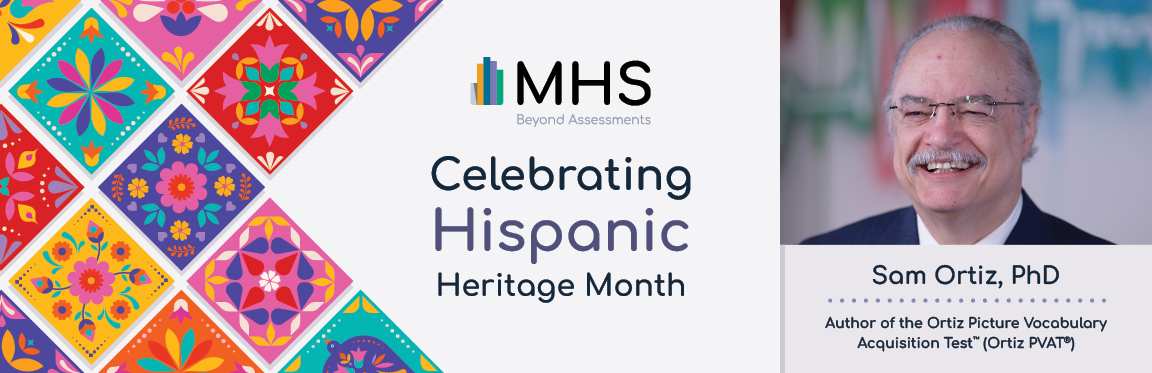
We spoke with Dr. Sam Ortiz, author of the Ortiz Picture Vocabulary Acquisition Test™ (Ortiz PVAT®) and Professor of Psychology at St. John’s University. A bilingual and bicultural psychologist with specialized training in bilingual school psychology, Dr. Ortiz has published and consulted extensively on culturally and linguistically responsive assessment and the evaluation of English language learners (ELLs). We asked him about what his identity means to him, how it has influenced his work, and why he sees lived experience as a strength for the next generation of psychology professionals.
The interview below has been edited for length and clarity. The views expressed are those of Dr. Ortiz.
As we recognize Hispanic Heritage Month, can you share what your cultural identity means to you, both personally and professionally?
Dr. Ortiz: I didn’t know I was bilingual growing up. My parents were from Puerto Rico, so I was fluent in both English and Spanish, but it wasn’t until I was re-specializing from clinical psychology into school psychology that it hit me.
I happened to go to a very multicultural program at San Diego State University, and I was reading Jim Cummins’ work and D’Amico’s book in speech pathology and language development. That’s when I thought, “They’re talking about me,” because it was my life they were describing. I realized, “Oh my God, I’m bilingual and I’m bicultural.” I was 35 years old!
It may seem strange that I wouldn’t know that, but that’s how language inherently operates. My identity is everything because I never fully understood how it shaped me or brought me from architecture, the subject of my first college degree, to where I am today.
If I had known about these things earlier, it might have sped up that process. Bringing my personal history and professional identity together has been really rewarding and fulfilling. I’m passionate about what I do because it’s my life. It’s not just something that I went to school and learned about. For me, the realization of my bicultural identity came late, but boy, it really turned my life around.
What advice would you offer to Hispanic and Latino students or early-career professionals who are interested in psychology, assessment, research, or education?
Dr. Ortiz: If it’s something you want to do, you really should pursue it without fear or intimidation. We desperately need more people of color, more professionals from underrepresented backgrounds, and more bilingual individuals in science—particularly in psychology and test development.
You don’t find a lot of test authors whose last names end in Z, like mine, but there should be a whole lot more! Who better to understand what is required in culturally and linguistically responsive assessment than someone who has experienced what it’s like to grow up with two languages and two cultures?
Multicultural and multilingual individuals bring valuable perspectives to areas like ideation, creativity, and problem-solving. The challenge may be learning the language of academia and science, but as you become more familiar with it, much of the work may resonate with your own experiences.
If you want to pursue it, go for it. You can absolutely make it happen. Just remember, if opportunities are lacking, recognize the situation for what it is: a lack of opportunity, not a lack of ability.
What would you say to Hispanic and Latino students or professionals who may encounter bias or barriers in the field because of their background?
Dr. Ortiz: Being part of groups and organizations that bring together bilingual and multilingual professionals can be very affirming to be a part of. Nearly every year I have the good fortune of speaking at the Bay Area Bilingual Roundtable. It is a wonderful community of bright, like-minded people and one example of a space where your culture, heritage, and language are affirmed. It’s important to find those spaces where you feel seen.
It’s also important to keep in mind that the impact of your work extends well beyond yourself. I occasionally receive emails from people saying, “Thank you very much for the work that you’ve done. It has been really helpful and meaningful to me.” It’s not always easy for me to gauge the impact my work has had on others. But when I receive an email like that, I think, “I have to continue despite any biases I encounter. There’s no quitting.”
You have to keep going and recognize that your work can create a ripple effect for others in the field. Remember that your lived experience and your identity can’t be taken away from you. In psychology, that is a gift.
References
1 López, D., Ochoa, D., Romero, M., & Parr, K. (2020). Integrating Latinx/Hispanic culture, traditions, and beliefs into effective school psychology practice. Communiqué, 49(4), 1, 16–18. National Association of School Psychologists
2 American Psychiatric Association, & National Latino Behavioral Health Association. (2025, July 17). American Psychiatric Association and National Latino Behavioral Health Association announce strategic collaboration to advance Latino health. American Psychiatric Association. American Psychiatric Association