

Conners CBRS® 2: Moving from Complexity to Confidence
A trusted broadband assessment, reimagined with updated norms, expanded content, and a modern domain framework to support clearer diagnostic, eligibility, and intervention decisions.
A Growing Need for Clarity in Youth Assessment
Youth receiving psychological services rarely arrive with a single, clearly defined concern. More often, they present with complex, overlapping behavioral, emotional, social, and academic difficulties. In both clinical and educational settings, making well-informed decisions requires more than isolated symptom counts. It requires a structured understanding of how concerns cluster, how they differ across settings, and how much they affect daily functioning. That need has become especially urgent amid rising youth mental health concerns and mounting pressure on professionals to make sound, timely decisions with limited resources.
Building on the legacy of Conners Comprehensive Behavior Rating Scales™ (Conners CBRS®), MHS is proud to announce the launch of Conners Comprehensive Behavior Rating Scales™ 2nd Edition (Conners CBRS® 2), a modern multi-rater broadband assessment of youth ages 6–18 years. It provides a structured, evidence-based view of an individual’s functioning across Parent, Teacher, and Self-Report perspectives. Designed to support confident decision-making, Conners CBRS 2 delivers breadth and depth from initial screening through follow-up planning.
Why Conners CBRS 2?
Conners CBRS 2 is a meaningful evolution of the original Conners CBRS. Updated to reflect current diagnostic frameworks and the needs of educational and clinical settings, this edition helps professionals move from broad concerns to a clearer understanding of symptom patterns, functional impact, and next steps.
Guided by extensive research, clinician feedback, and expert review, the revision introduces updated normative data, enhanced fairness and cultural sensitivity, greater alignment across Parent, Teacher, and Self-Report forms, improved validity metrics to support confidence in results, and expanded content coverage across key areas of psychopathology. Together, these enhancements deliver a modern, evidence-based assessment that supports more accurate, comprehensive, and meaningful evaluation of youth.
What’s New in Conners CBRS 2
To better support the complex decisions professionals make every day, Conners CBRS 2 includes several important enhancements:
- Improved alignment across Parent, Teacher, and Self-Report forms, enabling more direct comparison of information from different informants.
- Revised item content informed by advances in youth mental health research, with input from language experts to improve clarity, cultural sensitivity, and fairness across diverse populations.
- Most Content and DSM Symptom Scales are now organized into four clinically meaningful domains (Strengths, Neurodevelopmental, Externalizing, and Internalizing) to help identify broader patterns in a youth’s behavior and functioning.
- New and expanded Content Scales, including Resilience, Social Skills, Disinhibition, Aggression, and Callousness.
- Updated DSM Symptom Scales aligned to current DSM-5-TR criteria.
- Updated Clinical Indicator Items now include Disruptive Mood Dysregulation Disorder, Risky Behaviors, Eating Disorder, and Problematic Internet Use.
- Expanded Impairment & Functional Outcome Items now capture impairment across five areas of functioning.
- The Self-Report form has been split into two age-specific versions: Self-Report–Child (ages 8–12) and Self-Report–Adolescent (ages 13–18).
- Expanded Response Style Analysis, including a revised Inconsistency Index and Negative Impression Index, a new Omitted Items indicator, and a new Pace indicator for online administrations.
- Updated normative data from diverse U.S. and Canadian samples, stratified by key demographic variables to reflect national populations. Extensive item revisions across scales include improvements for cultural sensitivity and greater clarity from language experts to support diverse test-takers.
Conners CBRS 2 Scale Structure
The Conners CBRS 2 scale structure organizes results into broad domains and specific scales, making it easier to interpret patterns across informants and connect findings to follow-up assessment, eligibility, intervention, and monitoring needs.
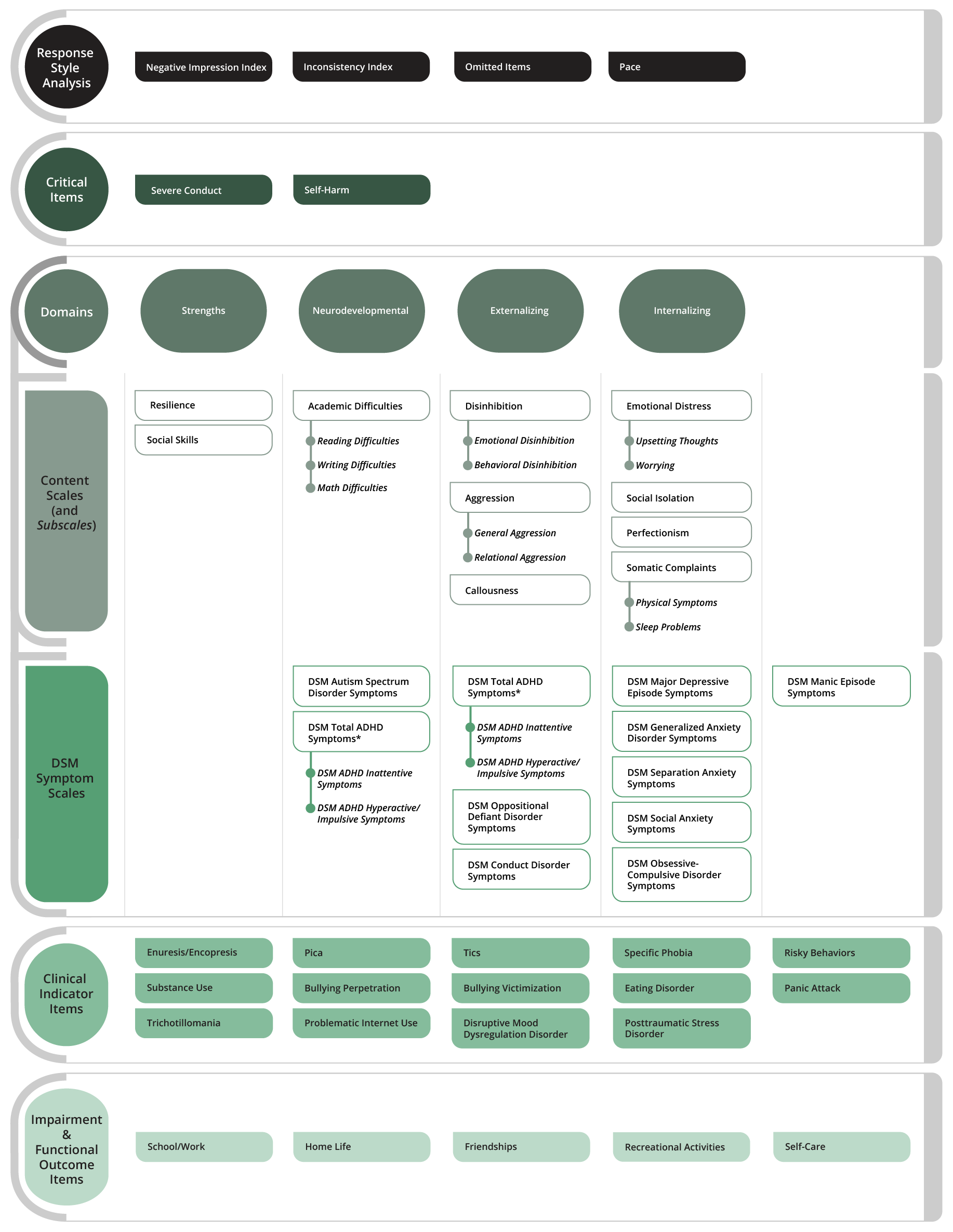
Note. DSM Autism Spectrum Disorder does not appear on Conners CBRS 2 Self-Report. Callousness and Perfectionism do not appear on the Self-Report–Child. *DSM Total ADHD, Inattentive, and Hyperactive/Impulsive Symptoms scales appear on both the Neurodevelopmental and Externalizing domains.
Supporting Professional Decision-Making
Conners CBRS 2 is built to support differential consideration across a wide range of presentations. It helps detect meaningful symptom patterns, identify the severity and functional impact of concerns, differentiate between overlapping presentations, and determine where more targeted follow-up assessment may be needed.
- In school settings, findings can support eligibility, re-evaluation, and service-planning decisions.
- In clinical settings, results can support diagnostic clarification, treatment planning, progress monitoring, and objective evidence of intervention response over time.
Content and DSM Symptom Scale scores reveal patterns across the Strengths Domains, Neurodevelopmental, Externalizing, and Internalizing. Cross-form alignment between Parent, Teacher, and Self-Report supports multi-informant interpretation and a more complete understanding of symptom presentation.
As a broadband measure, Conners CBRS 2 helps identify broad areas of concern and determine where deeper, targeted assessment may be useful. Elevated Neurodevelopmental Domain scores may indicate the need for follow-up assessment of neurodevelopmental concerns, such as Conners 4th Edition™ (Conners 4®) for attention-deficit/hyperactivity disorder (ADHD), Autism Spectrum Rating Scales™ (ASRS®) for autism spectrum disorder (ASD), or Comprehensive Executive Function Inventory™ (CEFI®) for executive function. Elevated Internalizing Domain scores may prompt follow-up for anxiety or depression, such as Multidimensional Anxiety Scale for Children 2nd Edition™ (MASC 2®) for anxiety or Children’s Depression Inventory 2nd Edition™ (CDI 2®) for depression.
Conners CBRS 2 integrates strengths such as Resilience and Social Skills alongside areas of concern. This balanced view supports more thoughtful interpretation and strength-aligned intervention planning, helping professionals understand not only a young person’s challenges but also the assets they can build on.
Conners CBRS 2 brings together broadband insight, multiple perspectives, and a modern interpretive framework to support clearer clinical and educational decisions. Whether you’re an existing Conners CBRS user or evaluating the tool for the first time, now is the moment to see how it fits your work.
Accessing Conners CBRS 2
Conners CBRS 2 is available through the MHS Online Assessment Center+ (MAC+), which allows you to administer, score, and generate reports quickly and easily. Simply visit the Conners CBRS 2 storefront page to purchase Uses and begin digital assessments right away. If you are an existing Conners CBRS user, you can enable Conners CBRS 2 on MAC+ and use existing Conners CBRS inventory to score and generate Conners CBRS 2 reports. If you don’t already have a MAC+ account, you can create one during checkout by using the email address you’d like associated with your new account. Once your purchase is complete, your MAC+ account will be created. Please allow one to two business days for activation.
For organizations seeking a more customized experience, the full Conners CBRS 2 lifecycle, including administration, scoring, results, and reports, can also be integrated into existing platforms and workflows via Universal REST API. Our consulting team will work closely with you to develop a solution and implementation plan that supports your organization’s specific requirements while aligning with your unique goals. Contact our customer service team and mention “API Integration,” and we will get in touch with you promptly.
Have general questions? Connect with a member of our team today—we’re happy to help!