
What Emotional Intelligence Reveals About Remote Work
Key Takeaways
- Remote work challenges are not one-size-fits-all. Remote work expands access to talent regardless of location but can also create challenges around communication and loneliness. Remote workers may struggle more with some remote work challenges over others depending on their ability to connect emotions to their experiences.
- Emotional intelligence may help explain these differences. Our research found that remote workers who were more likely to use emotions to inform their thinking and relate to others through empathy were more likely to report loneliness as their biggest challenge, whereas those less likely to do so were more likely to report communication as their primary challenge.
- Support should be personalized. Emotional intelligence insights can help organizations tailor development to employees’ individual strengths, experiences, and needs.
Remote work is here to stay, but the experience is not the same for everyone. Approximately 20% of people are remote workers, with 98% of workers having the desire to work remotely at least some of the time.¹ There are benefits of remote work for both employees and the organization: employees experience greater flexibility in their jobs, whereas organizations gain access to broader global talent.² At the same time, remote work can introduce distinct challenges that are experienced differently in traditional in-person settings. Organizations may overlook the unique challenges remote workers face, leaving employees without the training and resources needed to navigate them effectively.³ To support remote employees effectively, organizations may need to focus on two key challenges: navigating communication in virtual environments and maintaining a sense of belonging in dispersed teams.
When Virtual Communication Loses Important Cues
One notable difference between remote and in-person work environments is how employees communicate. Remote workers often communicate across dispersed locations, time zones, and through asynchronous digital channels. Each of these factors adds another a layer of complexity to workplace communication. Beyond these logistical challenges, virtual communication also provides fewer nonverbal and vocal cues, such as facial expressions, tone, pace, and emphasis. These cues help convey meaning and allow people to interpret messages more accurately. When these cues are limited or absent, employees may find it harder to interpret meaning, maintain shared understanding, and build connections with other people.³
When Flexibility Leads to Loneliness
Building connection is at the crux of another key remote work challenge: loneliness. Social isolation and loneliness can be particularly relevant issues for remote employees, especially when opportunities for informal interaction are limited.⁴ Without the spontaneous, informal conversations that happen around the office, remote workers may have fewer opportunities to build meaningful connections with colleagues and develop a sense of belonging. One strategy to mitigate these feelings of loneliness and protect employee well-being is through offering emotional intelligence training.⁴
Why EI Matters in Remote Workplaces
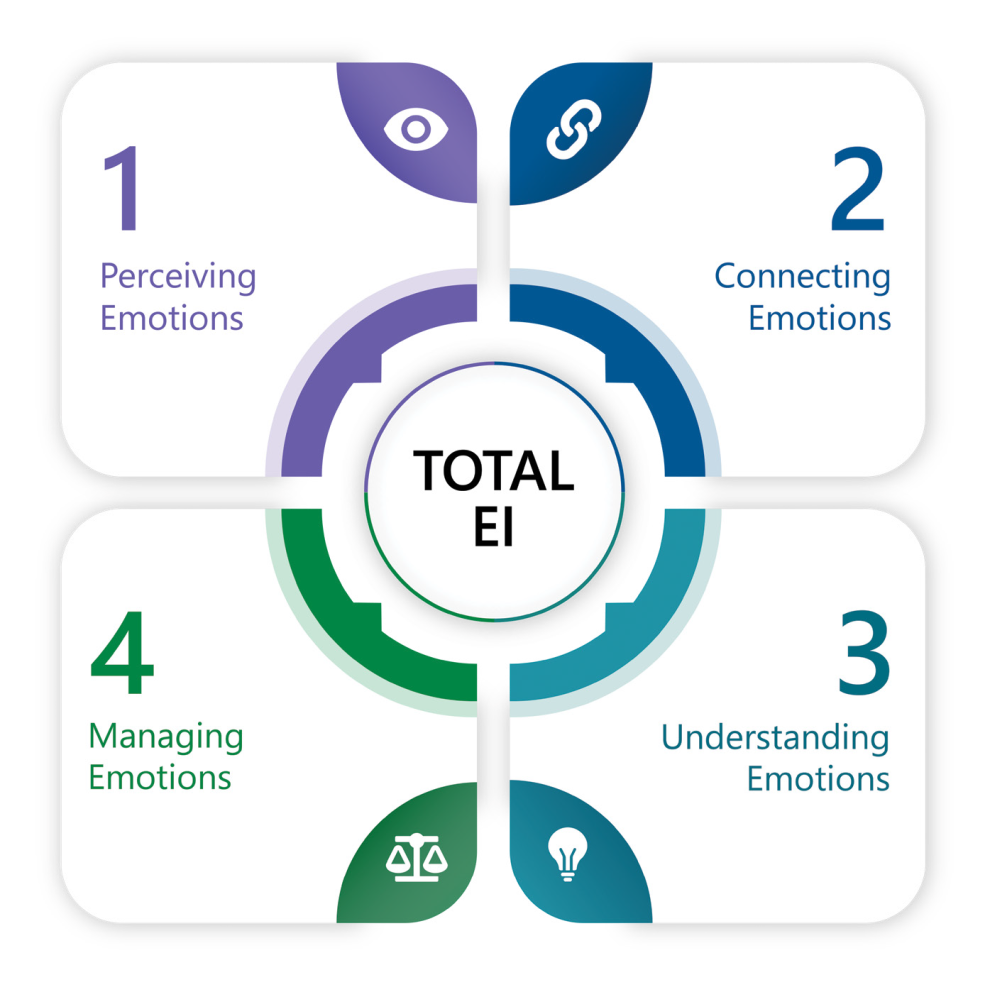
Emotional intelligence (EI) is defined as the capacity to reason about emotions and emotion-related information to enhance thinking⁵. To understand and evaluate EI, the Mayer-Salovey-Caruso Emotional Intelligence Test™ Second Edition (MSCEIT® 2) is an assessment designed to provide a clear, actionable understanding of how well an individual recognizes emotional cues, understands their causes and implications, and uses emotions as a source of information to facilitate smooth and effective interpersonal interactions. The MSCEIT 2 measures four domains of EI:
- Perceiving Emotions: the skills needed to perceive and accurately identify emotions in people and their environments
- Connecting Emotions: the skills needed to feel and use emotions to assist thought and connect with others through empathy
- Understanding Emotions: the skills needed to understand emotional information, including the meaning, causes and changes in emotions
- Managing Emotions: the skills needed to be open to your own emotions and those of other people, and the ability to reflectively manage emotions to make optimal decisions
What Our Research Revealed About Remote Work Challenges
We looked at data from 2,905 working adults who completed the MSCEIT 2 and examined the relationship between these scores and their reported remote work challenges.
Remote workers experienced a wide range of challenges, but the differences in reported challenges were largely driven by the Connecting Emotions domain. Connecting Emotions reflects a person’s ability to use emotions to support thinking and connect with others through empathy. These skills may be particularly relevant in remote environments, where employees have fewer opportunities to recognize and respond to emotional cues in person. In these environments, the ability to recognize emotional information, respond to others, and build meaningful relationships may become even more important.
Higher Connecting Emotions Scores: Loneliness Was More Often the Greatest Challenge
Remote workers particularly strong in Connecting Emotions found loneliness to be their biggest challenge. These employees may be more attuned to the role emotions play in thinking, problem-solving, and interpersonal experiences. When opportunities for meaningful interaction are limited, the absence of connection may be especially noticeable. This does not mean that stronger Connecting Emotions skills cause loneliness. Rather, employees who place greater value on emotional connection may experience its absence differently in a remote environment. Instead, limited social interactions through remote work can contribute to feelings of detachment, emotional strain, and reduced well-being and this effect could be more pronounced in remote workers scoring high on Connecting Emotions.⁴
Lower Connecting Emotions Scores: Communication Was More Often the Greatest Challenge
Remote workers with lower Connecting Emotions scores were more likely to report communication as their primary challenge. Employees with lower scores may find it harder to use emotional information to understand others, respond effectively, and navigate communication through virtual environments. These difficulties may become more noticeable when communication offers fewer nonverbal and vocal cues or occurs asynchronously. Prior research does find effective communication is especially hindered in remote environments because of reduced social cues, lower information richness, asynchronous communication, and barriers related to technology, language, and culture.³ Because of these challenges, employees with lower Connecting Emotions scores may also find it harder to establish shared understanding and interpersonal connections that support effective collaboration.
What This Means for Organizations
These findings suggest that a one-size-fits-all approach to helping people adapt to remote work environment may not address every employee’s needs. Instead, remote workers may benefit from different forms of support and professional development based on their Connecting Emotions skills.
Create Opportunities for Connection and Belonging
Employees with higher Connecting Emotions scores who identify loneliness as a concern may benefit from prioritizing and establishing opportunities for connection and belonging. Structured remote socialization opportunities, such as informal chats, mentoring programs, team-building initiatives, peer communities or online coffee breaks, may be particularly valuable for these employees. These approaches have been recommended as ways to reduce loneliness and strengthen social connection in remote work environments.⁴
Develop Skills for Clearer Virtual Communication
Employees with lower Connecting Emotions scores who identify communication as a concern may benefit from investment in virtual communication support. This support could focus on professional development with topics such as remote communication strategies, guidance on choosing the right communication channels, clarifying intent in written messages, checking for understanding when communicating with others, and building confidence in virtual collaboration. Research on remote teams suggests that targeted professional development can help employees navigate the unique communication demands associated with remote work.³ For example, building a development program surrounding the effective use of nonverbal communication in remote work may help those who score lower in Connecting Emotions.
From EI Insight to Individualized Development
- Recognize that remote workers face different challenges. Remote employees may share the same work setting, but do not experience virtual work challenges in the same way.
- Tailor support based on employee needs. Employees who struggle most with communication may benefit from targeted professional development in remote communication strategies, while those who struggle most with loneliness may benefit from more intentional opportunities for connection. Use the MSCEIT 2 to inform EI development. Although this research focused on remote employees, the implications extend to all workers. By understanding employees’ EI strengths and development areas, organizations can offer more personalized resources and training that help people communicate effectively, build stronger relationships, and feel more connected at work.
- Combine assessment insight with conversation. Remember, assessment results serve as a starting point for reflection and development, not as a label or substitute for understanding an employee’s individual experience. Use EI results alongside the employee’s goals, experiences, role, and work environment to identify development priorities.
- Measure whether support is helping. Revisit the employee’s experience over time to understand whether development activities are improving communication, connection, or confidence at work.
A More Personalized Approach to Helping Employees Thrive
Remote work challenges are not one-size-fits-all, and the support organizations provide should not be either. Findings suggest that EI, especially the ability to connect emotions, may help explain the unique challenges remote employees experience. While some struggle the most with communication, others find loneliness to be their greatest challenge. By combining the MSCEIT 2 with individualized development conversations, organizations can create more growth opportunities to help employees communicate effectively, build meaningful relationships, and feel more connected at work.
Turn EI Insight into Action: Discover how the MSCEIT 2 can help identify EI strengths and development opportunities to support more focused, personalized development.
Become Certified to Administer the MSCEIT 2: Build the knowledge and skills to administer, interpret, and apply MSCEIT 2 results in coaching, HR, and talent development settings.
References
¹ Haan, K. (2026, July 1). Top remote work statistics and trends. Forbes Advisor. https://www.forbes.com/advisor/business/remote-work-statistics/
² Krumm, S., Kanthak, J., Hartmann, K., & Hertel, G. (2016). What does it take to be a virtual team player? The knowledge, skills, abilities, and other characteristics required in virtual teams. Human Performance, 29, 123-142.
³ Schulze, J., & Krumm, S. (2016). The “virtual team player”: A review and initial model of knowledge, skills, abilities, and other characteristics for virtual collaboration. Organizational Psychology Review, 7, 66-95.
⁴ Figueiredo, E., Margaca, C., & Sanchez-Garcia, J. (2025). Loneliness and isolation in the era of telework: A comprehensive review of challenges for organizational success, Healthcare, 13, 1-28.
⁵ Mayer, J. D., Salovey, P., & Caruso, D. R. (2025). MSCEIT 2 technical manual: Mayer-Salovey-Caruso Emotional Intelligence Test (2nd ed.). Multi-Health Systems.