Give to Gain: A Conversation with Marion Salmon, Chief HR Officer at MHS
In conversations about women in leadership, we often focus on the glass ceiling, or the invisible barrier at the very top of the corporate ladder. But for many women, the real obstacle appears much earlier as a “broken rung” on the first step up to management. Long before C-suite titles are within reach, access to that initial promotion quietly determines who advances and who may be left behind.
For over a decade, LeanIn.Org and McKinsey & Company’s Women in the Workplace report has tracked women’s movement through the corporate pipeline. While women now hold 29% of C-suite roles—up from 17% in 2015—that progress masks a persistent bottleneck at the first promotion.1 For every 100 men promoted into their first management role, about 93 women make the same leap, and the gap is even wider for women of color, with just 74 women of color advancing for every 100 men.1 The result is compounding underrepresentation at every level above.
The 2025 report adds a new and concerning dimension: corporate commitment to women’s advancement is slipping, part of a several-year trend in declining commitment to gender diversity.1 Only half of companies say they are prioritizing women’s career progression, and for the first time, researchers identified a measurable ambition gap where women report being less interested in promotion than men. However, the data reveals something critical: When women receive the same sponsorship, advocacy, and managerial support as men, that ambition gap disappears. The issue isn’t motivation, but access to opportunity and support.1
This year’s International Women’s Day theme, Give to Gain, challenges us to consider how we can accelerate progress through generosity, reciprocity, and active support.2 Giving, whether through sponsorship, mentorship, visibility, advocacy, or opportunity, is not a subtraction. It’s multiplication.
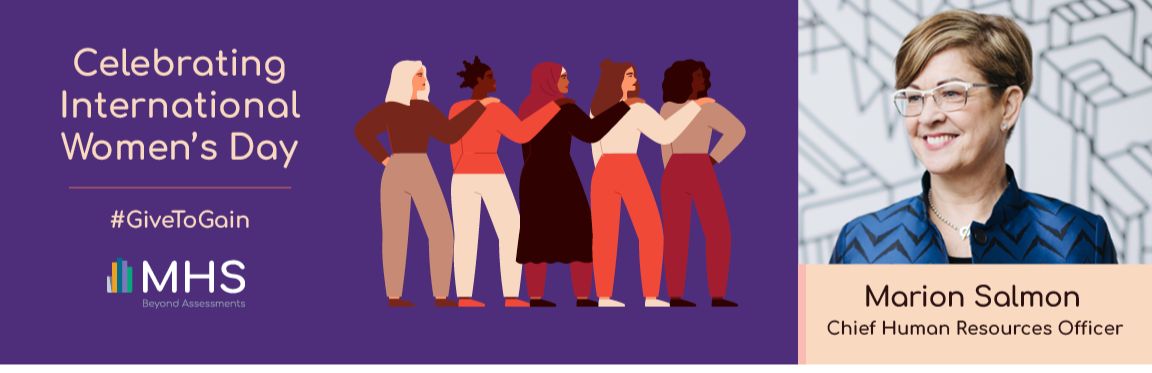
To explore what that looks like in practice, we spoke with Marion Salmon, Chief HR Officer at MHS. With more than 20 years of experience in consulting, coaching, and organizational development across industries ranging from engineering to media, Marion has built her career around developing leaders and strengthening culture. A passionate advocate for authenticity and growth, she believes people come to work wanting to do a good job, and that how we achieve results matters as much as the results themselves. In our conversation, she shares her perspective on mentorship, advocacy, leadership development, and how organizations can “give to gain” in meaningful, measurable ways.
This year’s theme of International Women’s Day is “Give to Gain,” which encourages generosity and collaboration to achieve gender equality. Drawing on your experience in talent and leadership development across diverse industries, how do you try to embody this mindset in your own leadership practices at MHS?
MARION: At MHS, our foundation in psychological science and our founders’ values deeply influence how we support and engage our people. “Give to Gain” resonates with the culture we strive to create because it’s grounded in trust, inclusion, and fairness. These principles shape my own leadership: I believe in people, and I believe they show up wanting to do their best work. As our HR leader, it’s my priority to cultivate practices, processes, and an environment that enable success and put these values into practice every day.
One of the ways we bring this to life is through our approach to Continuous Performance Development. It’s built around regular check-ins, open communication, and being generous with feedback and recognition. When leaders give people time and clarity, employees gain confidence and focus, and that’s when everyone does their best work.
You’ve spent much of your career designing and leading leadership development initiatives. What role do assessment, feedback, or self-awareness play in helping individuals build confidence and capability—both for their own growth and in how they support others?
MARION: Self-awareness is key to growing! People who continuously reflect and seek insights into their relationships and performance are more likely to reach their goals. Formal assessments play an important role in building self-awareness by providing a framework and language to discuss strengths, development areas, and interpersonal dynamics that one may not have had access to before. These tools reduce a lot of the awkwardness or anxiety many feel when talking about themselves and provide a structured way to explore alignment or misalignment between self-perception and others’ perceptions. When we help people understand themselves better, we enable them to show up more effectively for others. Give feedback, gain awareness—it’s a win-win!
From your perspective as a mentor and a team builder, what do you see as the key difference between having someone who advises you versus someone who actively advocates for you, and why is that distinction especially important early in a woman’s career?
MARION: Coaches and mentors often ask thoughtful questions to help you arrive at your own conclusions, and they also give advice based on their experience, which is valuable for navigating organizational dynamics and relationships. But advocacy is something you can’t underestimate. When a respected leader actively speaks up for you, it gives you credibility by association. That said, advocacy is a two-way street. No one will risk their reputation unless you’ve earned their trust and consistently delivered. That’s what makes it such a meaningful relationship.
As women, we often don’t get equal access to mentorship and advocacy. At the start of my career, I found that informal mentoring opportunities often went to men. Women sometimes need to be more proactive and assertive in seeking mentorship. If there’s a formal program, great—put your hand up. But if there isn’t, you need to ask yourself: Who could help me with this, and how can I get an introduction?
In your role at MHS, how does the organization support leadership development and mentorship, particularly for women and emerging leaders looking to grow into more visible or influential roles?
MARION: MHS is pretty unique in that it’s a predominantly female organization, with over 70% of our leaders and 50% of our executive team being women. We place a huge emphasis on experience—promoting from within, moving people across teams to expose them to different parts of the business, and involving them in a wide variety of projects and products so they can build breadth and confidence.
We also invest formally in development. We have a tuition assistance program and have a strong track record including several employees currently pursuing master’s degrees. We also incorporate leadership development into our in-person leadership meetings. For emerging leaders, particularly first-time managers, we’ve designed a development program that includes training and assessments like the EQ-i 2.0, and cohort-based peer support where new-to-MHS managers help newly promoted managers with leadership advice, and the long-tenured but new-to-leadership MHS managers help the newly hired navigate the organization.
Our focus is on building strong leaders within an environment that already supports and advances women in purposeful ways.
Have you seen examples of reciprocity within workplace culture—whether through mentorship, sponsorship, or leadership support—that made a meaningful difference in someone’s growth or advancement?
MARION: We have a very generous, engaged, and inclusive culture at MHS, and our most recent internal survey really reinforced that. The primary theme was that the environment at MHS allows employees to feel respected, valued, and supported, with strong team cohesion and a genuine sense of belonging. Are we perfect? Oh, goodness, no. There’s always an opportunity for improvement, but all of that is happening on a very strong foundation.
We also have very low turnover and many long-tenured employees, which I think speaks volumes about an inherent culture of reciprocity. With strong relationships and internal mobility, reciprocity becomes part of how the organization functions. People support one another, advocate for growth, and help remove obstacles.
There are countless examples of this in action. To name just a few, Hazel Wheldon started her career here as a vice president and went on to become CEO. Pooja Kaushal joined as a user experience designer and is now Director of User Experience. Sarah Rzepa [Director of Research and Development] and Claudia Roy [Director of Contracts and Legal Operations] both built their careers here and now hold director-level roles. And of course, Jenni Pitkanen, who began as a research scientist and is now our Chief Product Officer!
This growth and these outcomes don’t happen by accident. They’re the result of strong relationships, sponsorship, openness to feedback, and a genuine willingness to keep learning. That reciprocity—giving support, receiving it, and then paying it forward—is deeply embedded in our culture.
Fixing the broken rung will require intention and a willingness to give in ways that create lasting opportunity. When leaders provide sponsorship, visibility, and belief early in a woman’s career, everyone gains.
Learn more about International Women’s Day and the “Give to Gain” theme: https://www.internationalwomensday.com/
References
1 LeanIn.Org, & McKinsey & Company. (2025). Women in the workplace 2025. https://womenintheworkplace.com
2 International Women’s Day. (2026). International Women’s Day 2026 theme is “Give To Gain”. IWD: International Women’s Day 2026 theme is ‘Give To Gain’