

Feedback and Emotional Intelligence: A Pathway to Professional Growth
In high-performing organizations, feedback isn’t just a tool—it’s part of the culture. If done well, feedback can fuel growth, spark collaboration, and drive continuous improvement. Whether it’s a manager’s thoughtful guidance, a peer’s shared observations, or a team’s reflection on shared outcomes, feedback helps individuals adapt and excel. Feedback allows individuals to refine their skills, adjust their behaviors, and align with team goals. In collaborative environments, feedback fosters transparency, accountability, and continuous improvement. Organizations with effective feedback practices have been shown to have a competitive advantage, greater creativity, more trust, and increased motivation1,2.
Despite its importance, conversations around feedback can present a challenge for many professionals. Part of the challenge is that feedback is often emotionally charged, requiring vulnerability, trust, and the ability to regulate one’s emotions—which are skills central to emotional intelligence (EI). At its core, EI is the ability to perceive and express yourself appropriately, develop and maintain social relationships, cope with challenges, and use emotional information in effective ways.
The extent to which feedback conversations can feel emotionally charged all depends on a person’s comfort level with giving and receiving feedback; that gauge is tied to their EI levels. Whether you’re leading a team or coaching others, EI plays a critical role in how effectively you communicate, build trust, and navigate sensitive exchanges—which in turn can influence the quality of feedback you give and the impact of feedback you receive.
Investigating EI and feedback
To look at the relationship between EI and people’s comfort levels with giving and receiving feedback, we administered the Emotional Quotient Inventory™ 2.0 (EQ-i 2.0® ) to a demographically representative sample of 2,947 people. This sample included individuals aged 18 or older, residing in North America, who were currently employed. The EQ-i 2.0 measures EI by providing a Total EI score, 5 composite scale scores, and 15 subscale scores. The EQ-i 2.0 subscales all focus on EI skills critical to workplace success3, 4.
Figure 1: The EQ-i 2.0 Model of Emotional Intelligence
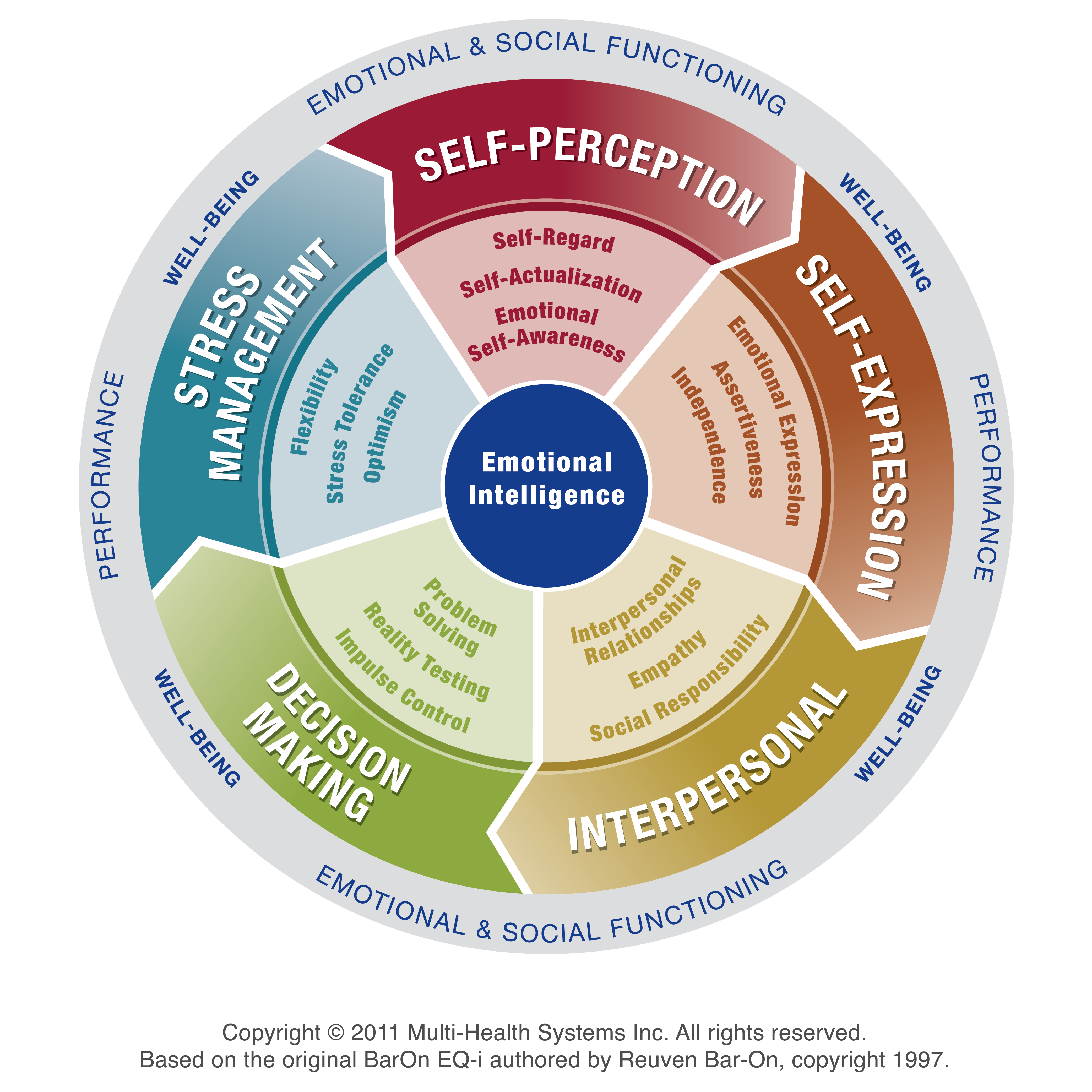
After completing the EQ-i 2.0, we asked the same people to answer some questions about how comfortable they are giving and receiving feedback to team members.
We found that higher Total EI was related to greater comfort with giving and receiving feedback. Overall, those who were higher in Total EI reported that they were more comfortable giving and receiving feedback to team members compared to those who were lower in Total EI. Although we see this relationship at an overall EI level, we hypothesized that it might be more nuanced and show up differently at the subscale level.
When we looked at the subscale level, we found that there were three subscales that stood out as having weaker relationships with attitudes toward giving and receiving feedback:
- Impulse Control is the ability to resist or delay an impulse, drive, or temptation to act. We found that the relationship between a person’s Impulse Control and their comfort level with giving and receiving feedback was weak. This finding means that people who scored higher on Impulse Control did not indicate that they are more comfortable giving or receiving feedback to team members than people with lower scores for Impulse Control. This trend may be because those who are higher on Impulse Control are so focused on staying measured and composed that they remain neutral in feedback conversations and somewhat avoid these types of emotionally vulnerable conversations.
- Empathy is the ability to recognize, understand, and appreciate how other people feel. Like Impulse Control, we found that the relationship between people’s Empathy score and their comfort level with giving and receiving feedback was weak. This result means that those who scored higher on Empathy are not overly comfortable giving or receiving feedback to team members. Highly empathetic individuals may worry about causing emotional distress or internalize others’ discomfort, leading them to indicate a lack of comfort with giving or receiving feedback, even though they may be cognitively aware of its importance. Their tendency to prioritize other people’s feelings could be interfering with their ability to provide candid feedback.
- Independence is the ability to be self-directed and free from emotional dependency on others, especially when operating in emotionally charged settings. We found that the relationship between people’s Independence scores and their comfort with giving and receiving feedback was weak. Those who score high on Independence may feel they don’t need external input, or they may view feedback as unnecessary unless it aligns with their goals. As a result, they may be less inclined to initiate feedback conversations or receive it openly, instead placing more value on reflecting on their own behavior without considering others’ perspectives.
We also looked at what components of the EQ-i 2.0 model were more strongly related to someone’s comfort level of giving and receiving feedback and found that:
- Assertiveness, which is the ability to communicate feelings, beliefs, and thoughts openly, was the subscale that had the strongest relationship with someone’s comfort level with giving feedback. Individuals high in Assertiveness may be more inclined to initiate and express their advice than those lower in Assertiveness.
- Interpersonal Relationships, which is the ability to develop and maintain mutually satisfying relationships characterized by trust and compassion, was the subscale that had the strongest relationship with someone’s comfort level with receiving feedback. Individuals who excel at Interpersonal Relationships likely place value on the opinions of others and are receptive to hearing input from others.
What does this all mean for coaching conversations?
These findings offer valuable insights for leadership development, coaching, and team dynamics.
Don’t assume high EI means general feedback comfort. Although, overall, those who have higher EI are more comfortable giving and receiving feedback, this relationship is nuanced at the subscale level, and coaches and leaders should look beyond the Total EI score and explore specific subscales that influence feedback comfort. Certain profiles of scores might be more or less inclined to give feedback productively or receive it gracefully, and exploring these nuances can facilitate debriefing sessions, as well as professional growth opportunities.
Identify potential barriers to feedback. Flag potential barriers to comfort levels of giving and receiving feedback. If someone wants to improve their ability to give or receive feedback, look at their Impulse Control, Empathy, and Independence scores, and discuss if these subscales are presenting any barriers in their comfort level in the feedback process.
Focus on feedback-related EI traits. If someone wants to improve their ability to give or receive feedback, encourage them to develop traits that are more directly tied to feedback fluency, such as Assertiveness or Interpersonal Relationships.
Emotional intelligence is a powerful asset in the workplace, and its relationship with feedback changes with emotional and social functioning. By understanding these dynamics, leaders and coaches can cultivate more emotionally intelligent teams, where feedback is not just given and received, but embraced as a pathway to growth for individuals and those they collaborate with.
Want to learn more about the EQ-i 2.0 and how it can be used for individual and team professional development? Get in touch with a member of our team.
References
1 Baker, N. (2010). Employee feedback technologies in the human performance system. Human Resource Development International, 13(4), 477–485.
2 Mulder, R. H. (2013). Exploring feedback incidents, their characteristics and the informal learning activities that emanate from them. European Journal of Training and Development, 37(1), 49–71.
3 Joseph, D. L., Jin, J., Newman, D. A., & O’Boyle Jr., E. H. (2015). Why does self-reported emotional intelligence predict job performance? A meta-analytic investigation of mixed EI. Journal of Applied Psychology, 100(2), 298–342.
4 Miao, C., Humphrey, R. H., & Qian, S. (2017). Are the emotionally intelligent good citizens or counterproductive? A meta-analysis of emotional intelligence and its relationships with organizational citizenship behavior and counterproductive work behavior. Personality and Individual Differences, 116, 144–156.