

Leading with Emotional Intelligence in Times of Uncertainty
Change isn’t slowing down — in fact, for many organizations and industries it’s speeding up. Today’s leaders are navigating global and domestic disruptions: from turbulence driven by economic crises, political unrest, advancements in artificial intelligence (AI), automation, and other technologies. Leaders face challenges they must confront during times of uncertainty, including how they will maintain stability and inspire confidence. Research shows that emotionally intelligent leaders are better equipped to handle such challenges due to their ability to process emotional information and use it strategically¹, ². Leaders with strong emotional intelligence (EI) tend to be more effective at managing stress, communicating cogently with key stakeholders, and cultivating resilience across their teams and organizations³. But what exactly is EI and how can we measure it in a meaningful way?
The Mayer-Salovey-Caruso Model of emotional intelligence
Although there are many definitions and theoretical approaches to EI, the Mayer-Salovey-Caruso Emotional Intelligence Test™ Second Edition (MSCEIT® 2) defines EI as the capacity to reason about emotions and emotion-related information to enhance thinking. Rooted in intelligence theory, the MSCEIT 2 views EI as a mental ability or skill; accordingly, the MSCEIT 2 assessment employs a performance-based approach to assessing EI. To do this, the MSCEIT 2 asks individuals to solve problems relating to emotions and emotional scenarios, rather than asking them, for example, about their perception of their emotional skills. This approach to measurement means that MSCEIT 2 scores are relatively unaffected by potential confounds such as self-esteem, emotional state, and response biases like social desirability and faking⁴, ⁵, ⁶, ⁷.
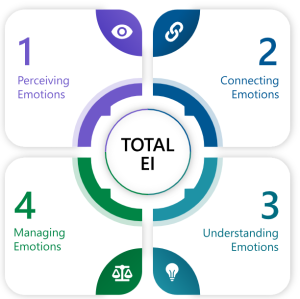
According to intelligence theory, on which the MSCEIT 2 is based, EI can be described as one overarching intelligence or ability that is composed of four closely related domains (depicted in Figure 1; MHS, 2025):
- Perceiving Emotions — The skills needed to perceive and accurately identify emotions in people and their environments.
- Connecting Emotions — The skills needed to feel and use emotions to assist thought and connect with others through empathy.
- Understanding Emotions — The skills needed to understand emotional information, including the meaning, causes, and changes in emotions.
- Managing Emotions — The skills needed to be open to your own emotions and those of other people, and the ability to reflectively manage emotions to make optimal decisions.
Figure 1.
Four Domains in the MSCEIT 2 Model
The MSCEIT 2 and leadership effectiveness
Decades of research have demonstrated that EI has an affirmative impact on effective leadership. In fact, having a high level of EI is an essential component of being a good leader. Why? Leaders are expected to not only manage their own emotions but to manage the emotions of others to ensure a positive and productive work environment⁸, ⁹, ¹⁰, ¹¹.
One such study was conducted by MHS¹² to examine the unique contribution of EI (as measured using the MSCEIT 2) in predicting leadership effectiveness. This study took into consideration the impact of transformational leadership (as measured by the Multifactor Leadership Questionnaire™ (MLQ)¹³) in a sample of 176 leaders. Results from this study showed that individuals who scored high on the MSCEIT 2 Total EI score were more effective leaders than those who scored low. This trend, although modest in size, was true over and above the impact of a transformational leadership style. Studies like this one demonstrate the value of considering EI when developing or selecting leaders for one’s organization. Additionally, the MSCEIT 2 approach is a framework that leaders may use to make or adapt decisions in emotionally intelligent ways as they take into account new information or changing circumstances.
Perceiving emotions
Emotional perception — the ability to accurately identify and interpret emotions in oneself and others — is a critical leadership skill during times of uncertainty or crisis. Leaders must accurately perceive and assess the emotional state of their teams and stakeholders since misreading emotions can lead to miscalculations, disengagement, and ineffective crisis response.
In turbulent times, employees often experience heightened stress, fear, and uncertainty. Leaders who are able to accurately perceive emotions can respond and adapt in more effective ways.
- In response to the heightened emotional state of their employees, leaders can implement strategies that foster psychological safety, ensuring employees feel supported and engaged despite external disruptions. Research shows that leaders who accurately perceive emotions can gauge team and organizational morale, allowing them to make informed decisions that align with employee needs¹⁴.
- Leaders who acknowledge and address emotional concerns within their teams also improve trust and organizational resilience². This means that leaders who excel at emotional perception should tailor their communication to match the emotional climate of their organization. By focusing on the portrayal of specific emotional cues — such as tone of voice and facial expressions — leaders can adjust their messaging to reassure, motivate, or clarify concerns. For example, studies indicate that emotionally perceptive leaders are more effective at crisis communications, reducing misinformation, and increasing stakeholder confidence¹⁴.
- Lastly, turbulence often demands flexible and adaptive leadership, and those who perceive emotional signals in a timely manner can proactively address concerns and adjust their strategies accordingly², ¹⁵.
Connecting emotions
In addition to emotional perception, turbulent environments often require leaders to build or support innovative solutions. Leaders who harness emotions, rather than suppress them, can enhance not only their own effectiveness, but also the performance of their teams.
- Research indicates that emotions, particularly positive emotions, can broaden cognitive flexibility and improve problem-solving abilities¹⁶, ¹⁷, ¹⁸. Leaders who know how to use emotions effectively can enhance their own and their team’s performance on cognitive tasks that involve creativity, problem solving, and strategic thinking¹⁶. Additionally, leaders who leverage emotions tend to be more skilled at creating persuasive messages that inspire teams and maintain motivation¹⁹.
- According to the MSCEIT 2, the Connecting Emotions domain also examines one’s ability to connect with the sensations that one feels when undergoing emotional experiences. Those who are better at connecting with emotional sensations may also display a greater capacity for empathy. Leaders who display empathy, especially in times of disruption and uncertainty, strengthen the sense of trust and connection that employees feel towards their organization. Research shows that employees are more likely to remain engaged and committed when they feel understood by their leaders¹.
Understanding emotions
In times of turbulence, leaders must manage uncertainty while maintaining stability within organizations. A crucial aspect of effective leadership in such situations is the ability to understand emotional information and predict emotional responses. Emotionally intelligent leaders can get to the root cause of emotional conflicts and predict how emotions evolve over time, helping them anticipate employee reactions to strategic decisions²⁰. This predictive ability enables leaders to navigate crises with foresight, communicate change effectively, and minimize resistance to change — all skills that are critical for times when organizations must pivot to accommodate unexpected opportunities or barriers.
- Leadership during turbulent times necessitates an understanding of complex emotional interactions to successfully navigate organizational dynamics. This involves understanding the relationships between different emotions as well as the causes of people’s emotions.
- Anticipating emotional reactions helps leaders implement changes more effectively. Leaders who can foresee how employees will respond to policy shifts can tailor their messaging to reduce anxiety and improve acceptance. Studies indicate that leaders who anticipate emotional reactions can encourage adaptive behavior¹⁵ and implement proactive strategies to maintain motivation and cohesion, helping their employees to meet future challenges with a more positive frame of mind¹.
Managing emotions
Emotional regulation is critical in high-pressure situations. According to the MSCEIT 2, emotional regulation involves implementing strategies to manage emotional responses. Leaders skilled in regulating their emotions are capable of maintaining composure and preventing reactive decision –making, helping to cultivate a sense of stability in uncertain times.
- Emotional self-management allows leaders to remain composed, think strategically, and make informed decisions rather than react out of fear, frustration, or impulse. Research shows that leaders who practice self-regulation enhance team confidence and organizational trust, which is crucial during crisis management¹⁵.
- Leaders who help teams manage their emotions contribute to a more stable and cohesive work environment. Implementing strategies such as empathetic listening and positive reinforcement improve morale and engagement, even during times of ². Studies show that leaders who prioritize emotional management strategies reduce workplace stress and improve team resilience¹.
How to shape the future of leadership with EI
In times of uncertainty and turbulence, leaders who perceive, connect with, understand, and manage emotions appropriately can foster trust, inspire resilience, and create a sense of stability for their employees. Strategic use of one’s EI is not just a nice bonus but a necessity during turbulent times. By developing their EI skills, leaders will be better positioned to increase the effectiveness of their organizations³.
The MSCEIT 2 provides a scientifically grounded framework for developing EI in leaders. It’s designed to provide a clear, actionable understanding of how well an individual recognizes emotional cues, understands their causes and implications, and uses emotions as a source of information to facilitate smooth interpersonal interactions. The MSCEIT 2 is a valuable resource that coaches and organizations can use to help leaders improve their effectiveness when the world feels increasingly unpredictable.
Ready to lead with the MSCEIT 2? Reach out to a member of our team today.
References
¹ Côté, S. (2014). Emotional intelligence in organizations. Annual Review of Organizational Psychology and Organizational Behavior, 1(1), 459-488.
² Ashkanasy, N. M., & Daus, C. S. (2005). Rumors of the death of emotional intelligence in organizational behavior are vastly exaggerated. Journal of Organizational Behavior, 26(4), 441-452.
³ Yadav, M., & Hung, T. H. (2025). Role of Emotional Intelligence in Crisis Leadership. In Emotionally Intelligent Methods for Meaningful Leadership (pp. 149-172). IGI Global Scientific Publishing.
⁴ Choi, S., Kluemper, D., & Sauley, K. (2011). What if we fake emotional intelligence? A test of criterion validity attenuation. Journal of Personality Assessment, 93, 270–277. https://doi.org/10.1080/00223891.2011.558870
⁵ Day, A. L., & Carroll, S. A. (2008). Faking emotional intelligence (EI): Comparing response distortion on ability and trait-based EI measures. Journal of Organizational Behavior, 29(6), 761–784. https://doi.org/10.1002/job.485
⁶ Tett, R. P., Freund, K. A., Christiansen, N. D., Fox, K. E., & Coaster, J. (2012). Faking on self-report emotional intelligence and personality tests: Effects
⁷ Walker, S. A., & MacCann, C. (2024). Faking good on self-reports versus informant-reports of emotional intelligence. Assessment, 31(5), 1011–1019. https://doi.org/10.1177/10731911231203960
⁸ Cote, S., Lopes, P. N., Salovey, P., & Miners, C. T. H. (2010). Emotional intelligence and leadership emergence in small groups. The Leadership Quarterly, 21, 496–508.
⁹ Dabke, D. (2016). Impact of leader’s emotional intelligence and transformational behavior on perceived leadership effectiveness: A multiple source view. Business Perspectives and Research, 4(1), 27–40.
¹⁰ Edelman, P., & van Knippenberg, D. (2018). Emotional intelligence, management of subordinate’s emotions, and leadership effectiveness. Leadership & Organization Development Journal, 39(5), 592–607.
¹¹ Kerr, R., Garvin, J., Heaton, N., & Boyle, E. (2006). Emotional intelligence and leadership effectiveness. Leadership & Organization Development Journal, 27, 265–279.
¹² Mayer, J. D., Caruso, D. R., & Salovey, P. (2025). Mayer-Salovey-Caruso emotional intelligence test second edition (MSCEIT 2) user’s manual. Multi-Health Systems, Inc.
¹³ Avolio, B. J., & Bass, B. M. (1995). Individual consideration viewed at multiple levels of analysis: A multi-level framework for examining the diffusion of transformational leadership. The Leadership Quarterly, 6(2), 199–218.
¹⁴ Joseph, D. L., & Newman, D. A. (2010). Emotional intelligence: An integrative meta-analysis. Journal of Applied Psychology, 95(1), 54-78.
¹⁵ George, J. M. (2000). Emotions and leadership: The role of emotional intelligence. Human Relations, 53(8), 1027-1055.
¹⁶ Fredrickson, B. L. (2001). The role of positive emotions in positive psychology. American Psychologist, 56(3), 218-226.
¹⁷ Kuhl, J. (2000). A functional-design approach to motivation and self-regulation: The dynamics of personality systems interactions. In Handbook of Self-Regulation (pp. 111–169). Academic Press.
¹⁸ Isen, A. M. (1999). Positive affect. In T. Dalgleish & M. J. Power (Eds.), Handbook of cognition and emotion (pp. 521–539). John Wiley & Sons.
¹⁹ Forgas, J. P. (2007). When sad is better than happy: Negative affect can improve the quality and effectiveness of persuasive messages and social influence strategies. Journal of Experimental Social Psychology, 43(4), 513–528.
²⁰ Mayer, J. D., Salovey, P., & Caruso, D. R. (2008). Emotional intelligence: New ability or eclectic traits? American Psychologist, 63(6), 503-517.