

Introducing the ASRS® Adult: A New Standard for Understanding ASD in Adults
Presentations of Autism Spectrum Disorder (ASD) are complex, blended, and recognized more often in adults today. With a growing awareness of ASD—its likely prevalence, presentation, and pattern of diagnosis among adults1,2—detection has become an important clinical focus. To support a healthcare pathway for adult diagnosis, MHS is excited to announce the launch of the Autism Spectrum Rating Scales™ Adult (ASRS® Adult). The ASRS Adult is a scientifically validated, adult-centered, multi-informant rating scale designed to assess symptoms and behaviors associated with ASD in individuals aged 18 years and older.
The new ASRS Adult offers a purpose-built rating scale for identifying, differentiating, and tracking ASD symptoms, behaviors, and associated features in adults. This rating scale includes both self-report and observer perspectives, with items, norms, and scoring tailored to an adult population—ensuring greater relevance and accuracy when assessing and supporting individuals beyond the pediatric stage. Additionally, the ASRS Adult introduces care to adults overlooked in childhood, offering a holistic and versatile measure of ASD at each life stage.
The ASRS Adult is a new adaptation of the original Autism Spectrum Rating Scales™ (ASRS®), which was developed for children and youth. Informed by the latest research, the ASRS Adult captures nuanced presentations such as masking and late-emerging traits—offering a modern, adult-centered approach to ASD evaluation that is psychometrically robust and accessible in design, test content, and scoring.
The ASRS Adult serves as a key part of a comprehensive evaluation battery. When used alongside data from other standardized assessments, results from the ASRS Adult can help inform diagnostic decisions, treatment planning, and monitoring. The ASRS Adult further provides a valuable framework to guide service allocation, where therapeutic decisions and tailored treatment plans align with an individual’s symptom profile by identifying specific areas of difficulty across key domains. This integrable rating scale can also provide data that supports eligibility recommendations for vocational and academic accommodations, workplace assistance, or therapeutic referrals.
Why did MHS develop the ASRS Adult?
ASD, as defined by the Diagnostic and Statistical Manual of Mental Disorders, Fifth Edition, Text Revision,3 is a neurodevelopmental condition characterized by persistent challenges in social interaction, communication, and repetitive behaviors, as well as restricted interests and activities. The severity and nature of symptoms vary widely, resulting in a spectrum of intellectual and adaptive functioning difficulties among autistic individuals. These challenges often manifest as behavioral and functional issues in everyday life.
In recent years, there has been a significant shift from focusing exclusively on early childhood ASD diagnosis and intervention to understanding ASD across the lifespan. The increasing recognition of ASD has led to a surge in adult diagnoses, and both clinicians and the public now value ongoing research in this area. Building on this shifting focus, recent studies have highlighted the importance of adult assessment. For example, Grosvenor and colleagues reported that adult ASD diagnoses have risen by over 30% in the past decade, underscoring a growing awareness and need for tailored evaluation tools.1 Their findings emphasize the necessity of accurate assessment and support for adults who may have been overlooked in childhood.
As a result of these changes, the demand for adult-focused ASD assessments is increasing. Many current diagnostic tools remain centered on childhood presentations, creating a gap in care for adults whose symptoms may have emerged or evolved later in life. This disconnect is particularly critical for those who were not screened as children, leaving many undiagnosed until adulthood. Existing disparities in prevalence and manifestation of ASD underscore a need for expanded diagnostic and specialty healthcare services catered to adult populations. Building on increased recognition and modern research, comprehensive assessments are vital to ensure that adults receive the necessary resources, accommodations, and tailored support to thrive in daily life.
Co-authored by renowned test development experts, Sam Goldstein, PhD, and Jack A. Naglieri, PhD, the ASRS Adult was developed to reflect scientific advances in ASD assessment specifically for the adult population. This measure fulfills one half of a larger diagnostic story while addressing a critical pain point: by aligning with the broader ASRS ecosystem, the ASRS Adult can help close the gap in ASD identification across adulthood.
Key features of the ASRS Adult
Strong psychometric properties
The ASRS Adult shows excellent evidence of reliability, validity, and fairness. It demonstrated high internal consistency across all forms and age groups, as well as strong evidence of test-retest and inter-rater reliability. Its robust validity evidence comes from strong model fit in confirmatory factor analyses, alignment with other standardized ASD measures, effective distinguishing power between individuals with ASD from the general population and other clinical groups, and an ability to offer high-classification accuracy. In terms of fairness, the ASRS Adult demonstrated unbiased measurement with regard to key demographic groups, supporting its generalizability.
Comprehensive scales
The ASRS Adult includes About the Ratings metrics—Duration, Omitted Items, Negative Impression Index, and Inconsistency Index—that help clinicians consider how the rater approached the ASRS Adult. These validity indicators are available in the full-length forms and provide essential context for interpreting scores, supporting confident decision making.
The full-length ASRS Adult includes a Total Score, which is a composite of two ASRS Adult Scales representing the two main symptomatic areas of ASD, a DSM/ICD Scale representing ASD symptoms based on the Diagnostic and Statistical Manual of Mental Disorders (DSM) and the International Classification of Diseases (ICD) criteria, and 10 Treatment Scales representing areas for intervention. The structure of the ASRS Adult is depicted in Figure 1 below.
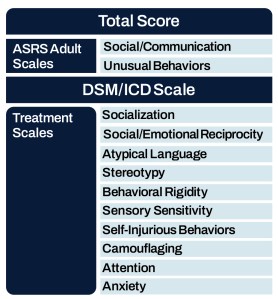
Figure 1.
Flexible administration
The ASRS Adult is available in two formats: full-length (ASRS Adult) and short forms (ASRS Adult–Short). The full-length form (96 items) is used for comprehensive diagnostic evaluations, while the short form (20 items) can be used for quick screening and progress monitoring. The ASRS Adult online is typically administered online where the clinician can either set up a local administration or email a test link directly to the rater. Paper administration is possible by printing paper forms, where the responses can then be entered for digital scoring and report generation.
A multi-informant approach
The ASRS Adult includes Self-Report and Observer versions. The Self-Report form is completed by the individual being evaluated, and the Observer form is typically completed by someone who knows the individual well (e.g., spouse, family member, friend). Collecting ratings from multiple observers and the person being evaluated provides a broad understanding of the individual’s behaviors and symptoms across various contexts and perspectives, which is important for considering a possible diagnosis of ASD and planning interventions.
The forms are available in English (North America), Spanish (North America), and French (Canada), with reading levels designed for accessibility—Grade 6 for Self-Report and Grade 7 for Observer.
Applications for the ASRS Adult
The ASRS Adult can provide valuable information in various contexts, such as clinical assessments of individuals, group screenings, treatment and progress monitoring, evaluation of treatment protocols, and selection or outcome measures in research.
- Clinical assessment: The ASRS Adult serves as a vital tool in the assessment and diagnostic process, forming a key part of a comprehensive evaluation battery. Although data from rating scales alone are insufficient for making an ASD diagnosis, these scales are a crucial part of a multi-method, multi-informant ASD evaluation.
- Differentiating between other co-occurring disorders: When used in conjunction with other measures, the ASRS Adult can help distinguish ASD from commonly co-occurring conditions like ADHD, anxiety, or mood disorders. For example, the ASRS Adult can work alongside ADHD rating scales like the Conners Adult ADHD Rating Scales™ 2nd Edition (CAARS™ 2) to differentiate between diagnoses that have overlapping symptoms.
- Treatment planning and progress monitoring: The ASRS Adult provides a valuable framework for guiding therapeutic decisions and tailoring treatment plans to meet an individual’s specific symptom profile. Clinicians can use the ASRS Adult to pinpoint specific areas of difficulty and develop interventions that directly address those challenges.
- Occupational and vocational settings: The standardized scores provide objective, norm-referenced data to support diagnostic impressions and clarify the presence and severity of autism-related symptoms that may hinder employment, self-care, and independent living. The ASRS Adult offers strong supporting evidence for disability claims that can lead to accessing specific resources and support.
Accessing the ASRS Adult
The ASRS Adult is available through the MHS Online Assessment Center+ (MAC+), which allows you to administer, score, and generate reports quickly and easily. Simply visit the ASRS Adult storefront to purchase Uses and begin digital assessments right away. If you don’t already have a MAC+ account, you can create one during checkout by using the email address you’d like associated with your new account. Once your purchase is complete, your MAC+ account will be created. Please allow one to two business days for activation.
For organizations seeking a more customized experience, the full ASRS Adult lifecycle—including administration, scoring, results, and reports—can also be integrated into your existing platform and workflows via Universal REST API. Our consulting team will work closely with you to develop a solution and implementation plan that supports your organization’s specific requirements while aligning with your unique goals. Contact our customer service team and mention “API Integration” and we will get in touch with you promptly.
Have general questions? Connect with a member of our team today—we’re happy to help!
References
1 Grosvenor, L. P., Croen, L. A., Lynch, F. L., Marafino, B. J., Maye, M., Penfold, R. B., Simon, G. E., & Ames, J. L. (2024). Autism diagnosis among US children and adults, 2011–2022. JAMA Network Open, 7(10), e2442218. https://doi.org/10.1001/jamanetworkopen.2024.42218
2 Stewart, G. R., & Happé, F. (2025). Aging across the autism spectrum. Annual Review of Developmental Psychology, 7, 461–484. https://doi.org/10.1146/annurev-devpsych-111323-090813
3 American Psychiatric Association. (2022). Diagnostic and statistical manual of mental disorders: Fifth edition (5th ed., text rev.). https://doi.org/10.1176/appi.books.9780890425787