

Early Detection of Emotional Dysregulation in Children with Autism Spectrum Disorder
If a preschooler throws themselves on the floor over a broken crayon, is it a tantrum or a signal of something deeper? At this age, it’s hard to tell. Emotional highs and lows are part of typical early childhood, making it difficult to distinguish developmentally normal frustration from patterns of dysregulation that can seriously interfere with learning, relationships, and long-term mental health.¹
Let’s consider emotional dysregulation—a pattern of experiencing or expressing emotions that interfere with functioning—which has been increasingly recognized as a meaningful dimension of neurodevelopmental disorders, particularly Attention Deficit/Hyperactivity Disorder (ADHD) and Autism Spectrum Disorder (ASD).2, 3, 4
In ASD, emotional dysregulation is common but not part of the diagnostic criteria, so it may not always be prioritized in assessment or intervention, even if it may be strongly related to core features of autism.2 This gap creates a risk that early emotional regulation challenges may go unrecognized, despite their potential long-term impact.
Why emotional dysregulation in early childhood matters
What it can look like:
- Disproportionate reactions to minor issues (for example, a change in routine)3
- Rapid and unpredictable mood shifts3
- Heightened emotional or sensory sensitivity (such as fixating on a past argument or disappointment)3
- Difficulty identifying or expressing emotions leading to frustration, withdrawal, and/or emotional outbursts2, 3
Why it’s often missed: Preschoolers’ behaviors vary widely, and without developmentally appropriate tools, it can be hard to differentiate typical from clinically meaningful patterns of emotional dysregulation. And because emotional dysregulation is not part of the ASD diagnostic criteria, it can receive less attention during assessments.
What’s at stake: Early emotional dysregulation is linked to later difficulties in mental health, peer relationships, and academic success.2,5 Research also shows that how emotions are managed matters: reliance on maladaptive emotional regulation strategies like suppression is linked to higher depression and lower well-being, while frequent use of adaptive strategies like reappraisal is associated with more positive outcomes, and can even buffer the effects of suppression.6 This highlights the importance of identifying challenges early, when adaptive strategies can be supported and strengthened.
What the research shows
To better understand how these behaviors present in early childhood, we analyzed parent-reported ratings of children aged 18 months to 5 years using the Autism Spectrum Rating Scales™ (ASRS®) and new item content that may contribute to its future revision. Six items reflecting emotional dysregulation behaviors were examined, including:
- Reactions to changes in routine (items 1 and 2)
- Sensory overload and emotional reactivity (items 3, 4, and 5)
- Muted or atypical emotional responses (item 6)
We compared ratings across two groups:
- General population: 240 children
- ASD group: 47 children
The following charts show how often these behaviors were reported across the two groups, with response options ranging from “never” to “very frequently.”
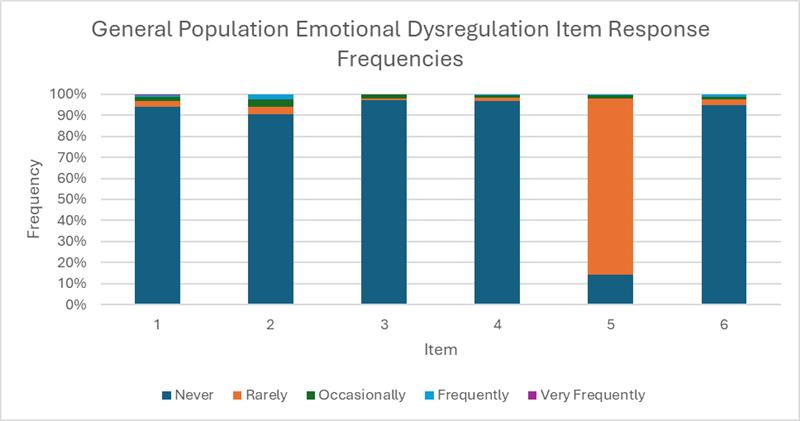
Figure 1. General Population Emotional Dysregulation Item Response Frequencies.
This chart shows the percentage of participants in the general population group who selected each response category for the six items reflecting emotional dysregulation
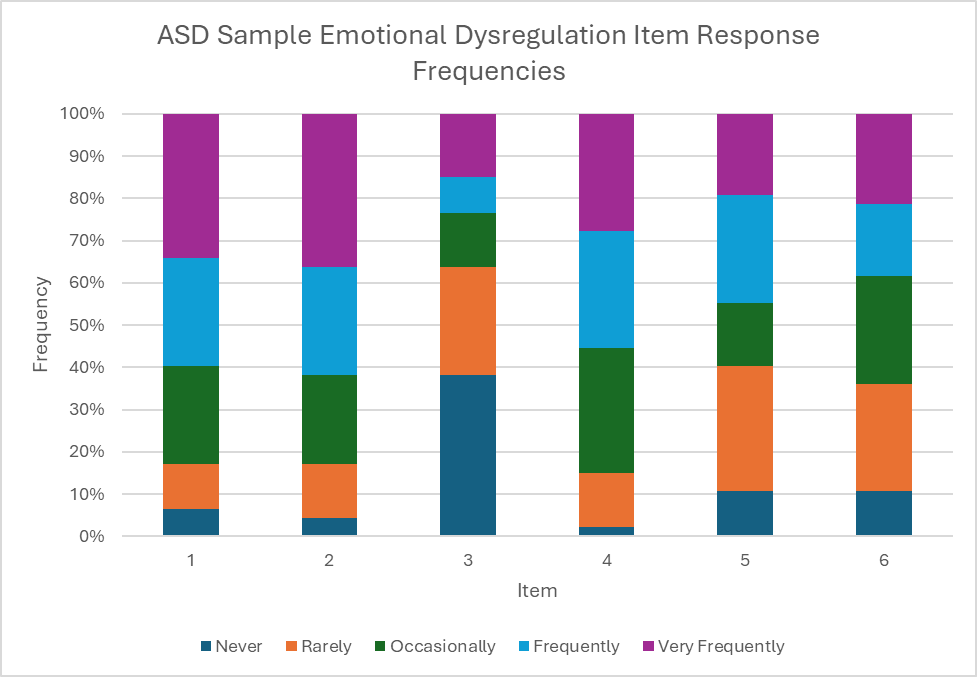
Figure 2. ASD Sample Emotional Dysregulation Item Response Frequencies.
This chart shows the percentage of participants in the ASD sample who selected each response category for the six items reflecting emotional dysregulation.
When comparing the ASD and general population samples, clear patterns emerged:
- Endorsement of the six items was predominantly lower in the general population sample, indicating minimal emotional dysregulation.
- In the ASD sample, the item responses were more elevated, reflecting more frequent emotional dysregulation.
Statistical analysis confirmed substantial group differences, with large effect sizes (as measured by Cliff’s delta7, or d; small effect = 0.15 to 0.32, medium effect = 0.33 to 0.46, large effect ≥ 0.47):
- General population versus ASD-only group: d = -0.54 to -0.96
What this means: The differences between the general population and the clinical samples are large enough to be clinically meaningful. These findings suggest that emotional regulation challenges associated with autism can be detected in children as young as 18 months to 5 years and distinguished from typical developmental variability. This highlights the importance of developmentally sensitive measures for capturing subtle signs of emotional dysregulation early—when they are easiest to miss.
Why this differentiation matters
- Reduces misinterpretation: Distinguishes developmentally typical variability from patterns that may warrant further evaluation.
- Supports early conversations: Provides clinicians and caregivers with a clearer basis for discussing emotional regulation challenges in ASD.
- Informs next steps: While not diagnostic, these insights can guide referral decisions, intervention planning, and family education.
Applying the research
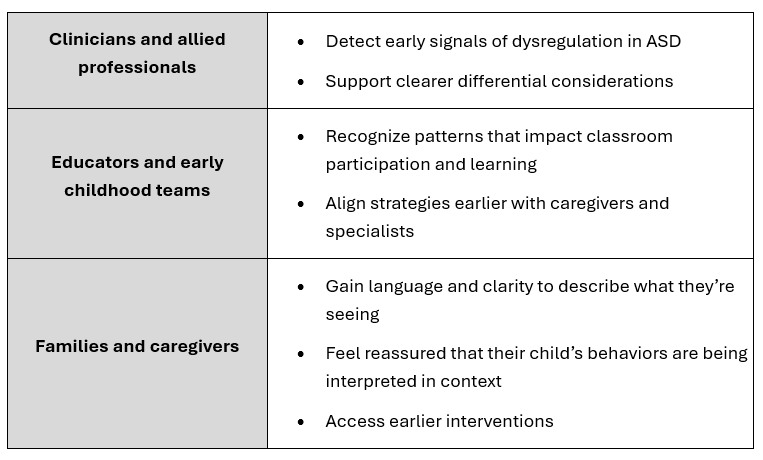
The ability to detect and differentiate emotional dysregulation from typical development even in preschool years has practical implications for multiple groups:
Responsible use and next steps
Emotional dysregulation does not equal a diagnosis. It’s a clinically important associated feature that can guide further assessment, conversation, and intervention. Ongoing research continues to explore developmental trajectories and the impact of early, targeted interventions.
Emotional dysregulation is a core challenge in ASD and other disorders, and one that too often goes unrecognized in the preschool years. The use of standardized tools that capture this complexity are critical for providing valuable insights that help clinicians interpret behaviors in context and act sooner.
Ready to dive deeper?
For professionals exploring emotional dysregulation across development, the Conners 4® Conners 4th Edition™: Leading ADHD Assessment for Youth (children 6+) and CAARS™ 2 Conners Adult ADHD Rating Scales™ 2nd Edition (adults) include dedicated Emotional Dysregulation scales, to capture these challenges in children and adults with ADHD.
Recognizing emotional dysregulation early can transform outcomes for children with ASD, but the journey doesn’t end there. Across the lifespan, the need for accurate and nuanced assessment remains critical. The future of adult ASD assessment is almost here, with the Autism Spectrum Rating Scales™ Adult (ASRS® Adult), which is designed to meet the unique challenges of evaluating ASD in those aged 18 and older. Subscribe to our Clinical newsletter to gain exclusive insights and updates on this scientifically validated, multi-informant rating scale.
References
1 Cole, P. M., Luby, J., & Sullivan, M. W. (2008). Emotions and the development of childhood depression: Bridging the gap. Child Development Perspectives, 2(3), 141–148. https://doi.org/10.1111/j.1750-8606.2008.00056.x
2 Dell’Osso, L., Massoni, L., Battaglini, S., Felice, C., Nardi, B., Amatori, G., Mirko Cremone, I., & Carpita, B. (2023). Emotional dysregulation as part of the autism spectrum continuum. Frontiers in Psychiatry, 14, 1234518. https://doi.org/10.3389/fpsyt.2023.1234518
3 Thompson, R. A. (2019). Emotion dysregulation: A theme in search of definition. Development and Psychopathology, 31(3), 805–815. https://doi.org/10.1017/S0954579419000282
4 Graziano, P. A., & Garcia, A. (2016). ADHD and children’s emotion dysregulation: A meta-analysis. Clinical Psychology Review, 46, 106–123. https://doi.org/10.1016/j.cpr.2016.04.011
5 Nuske, H., Hedley, D., Woollacott, A., Thomson, P., Macari, S., & Dissanayake, C. (2017). Developmental delays in emotion regulation strategies in preschoolers with autism. Autism Research, 10(11), 1808-1822.https://doi.org/10.1002/aur.1827
6 Cai, R. Y., Richdale, A. L., Dissanayake, C., Trollor, J., & Uljarević, M. (2019). Emotion regulation in autism: Reappraisal and suppression interactions. Autism: The International Journal of Research and Practice, 23(3), 737–749. https://doi.org/10.1177/1362361318774558
7 Romano, J., Kromrey, J. D., Coraggio, J., Skowronek, J., & Devine, L. (2006, October 14-17). Exploring methods for evaluating group differences on the NSSE and other surveys: Are the t-test and Cohen’s d indices the most appropriate choices? [Paper presentation]. Annual Meeting of the Southern Association for Institutional Research, Arlington, VA, United States.